
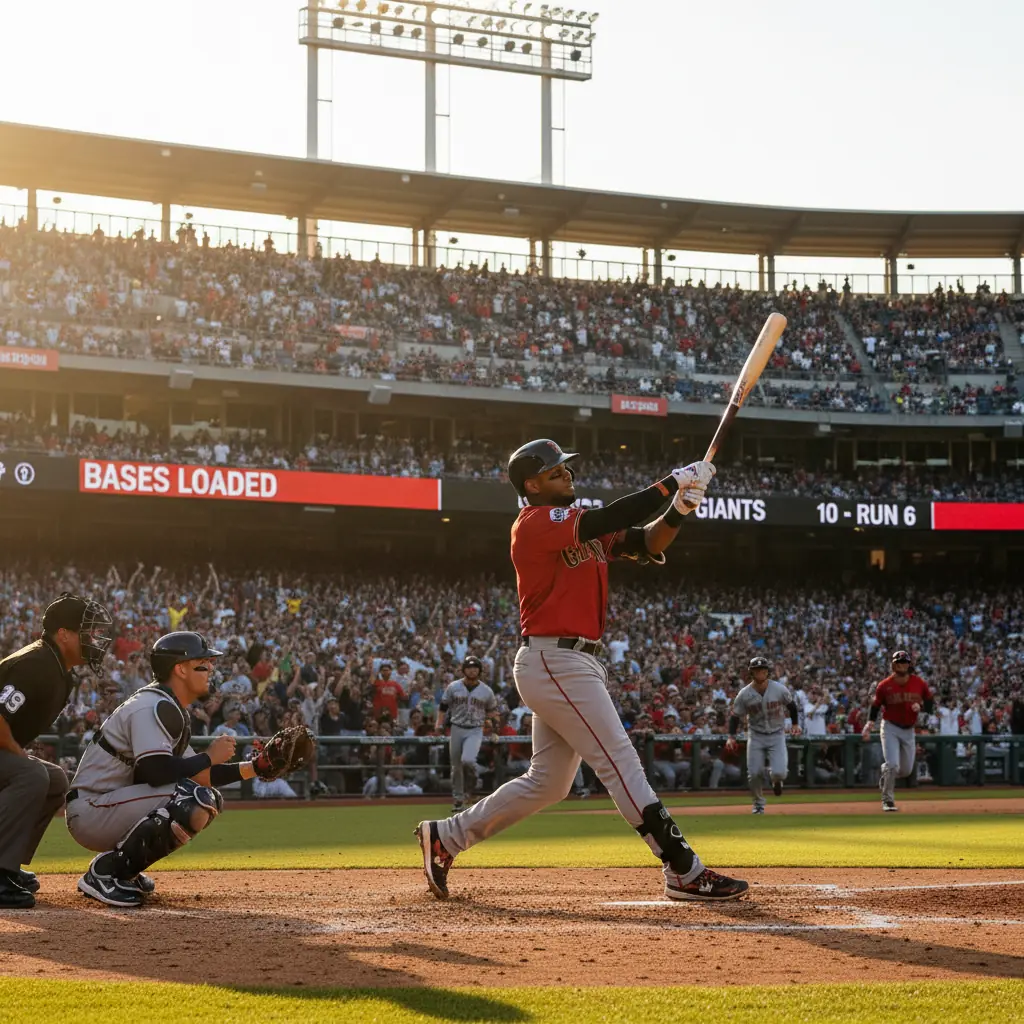
The crack of the bat, the roar of the crowd, and the satisfying sight of runners rounding the bases – few moments in baseball are as electric as a grand slam. These bases-loaded home runs are game-changers, capable of swinging momentum in an instant. But beyond the thrill, grand slams present a unique and potentially lucrative opportunity for savvy MLB bettors.
Forget simply picking the winning team. Understanding the intricacies of MLB grand slam odds opens a whole new dimension of strategic betting. It’s about anticipating those explosive moments, identifying the players most likely to deliver, and capitalizing on the potentially high payouts that come with this type of wager.
This guide will take you beyond the basics, diving deep into the world of MLB grand slam betting. We’ll explore the factors that influence grand slam frequency, how to analyze player statistics, and ultimately, how to make informed bets that could significantly boost your bankroll. Get ready to step up to the plate and swing for the fences – the world of grand slam betting awaits!
Understanding the Fundamentals of Grand Slams
A grand slam in baseball is arguably one of the most electrifying plays. It’s a home run hit with all three bases occupied by runners – first, second, and third – resulting in a four-run score. More than just adding runs, a grand slam can dramatically shift the momentum of a game, instantly turning a potential deficit into a lead or blowing a close game wide open. For fans, it’s an eruption of excitement, a moment of pure, unadulterated joy. For the team that hits one, it provides instant impetus.
From a betting perspective, the infrequency of grand slams makes them an enticing, though risky, proposition. Their rarity means that betting odds on a grand slam occurring in a game, or a specific player hitting one, tend to be quite high. This is what makes a grand slam a compelling betting opportunity. The less frequent an event, the more attractive the payoff. This adds spice to the game for those who like to add some skin in the game.
The Anatomy of a Grand Slam:
The conditions that lead to a grand slam are a confluence of strategic play and sheer luck. It all starts with getting runners on base. Singles, doubles, walks, and errors can all contribute to loading the bases. The batting order then becomes a crucial factor. With the bases loaded, the batter coming to the plate is often one of the team’s power hitters, someone known for their ability to drive the ball out of the park. The tension in the stadium is high, with every pitch carrying immense weight. A grand slam is not just about power, but also about timing, precision, and a little bit of good fortune.
Decoding Grand Slam Odds
Navigating the world of Grand Slam betting can seem daunting, especially when deciphering the various odds formats. Understanding these formats is crucial for making informed decisions and maximizing potential winnings. The three primary odds formats you’ll encounter are American, Decimal, and Fractional.
American odds, also known as moneyline odds, are expressed as either positive or negative numbers. A negative number (e.g., -150) indicates the amount you need to wager to win $100. So, if the American odds are -150, you would need to bet $150 to win $100. A positive number (e.g., +200) represents the amount you would win for every $100 wagered. If the American odds are +200, a $100 bet would yield a $200 profit.
Decimal odds represent the total payout for a $1 wager, including the return of your stake. For example, decimal odds of 2.50 mean that a $1 bet would return $2.50 (your initial $1 stake plus $1.50 in profit). To calculate the potential profit, simply subtract 1 from the decimal odds and multiply by your stake. For instance, with odds of 2.50 and a $50 stake, your profit would be (2.50 – 1) $50 = $75.
Fractional odds, commonly used in the UK, express the potential profit as a fraction of the stake. For example, odds of 2/1 (read as “two to one”) mean that you would win $2 for every $1 wagered. A $10 bet at 2/1 odds would yield a $20 profit. To convert fractional odds to decimal odds, divide the numerator by the denominator and add 1. For example, 2/1 would be (2/1) + 1 = 3.00 in decimal odds.
Converting between these formats is straightforward. To convert American odds to decimal odds: if the American odds are positive, divide by 100 and add 1 (e.g., +200 becomes 200/100 + 1 = 3.00). If the American odds are negative, divide 100 by the absolute value of the odds and add 1 (e.g., -150 becomes 100/150 + 1 = 1.67).
Calculating Expected Value:
Estimating potential outcomes in Grand Slam betting often involves calculating the expected value (EV) of a wager. The expected value is a measure of the average amount you can expect to win or lose per bet if you were to place the same bet repeatedly. While it doesn’t guarantee short-term results, it provides insight into the long-term profitability of a betting strategy.
One method involves assessing the probability of different outcomes, taking into account player form, head-to-head records, surface performance, and injury reports. Assign probabilities to each possible scenario, then multiply each probability by the potential profit or loss associated with that outcome. Summing these values gives you the expected value. A positive EV suggests a potentially profitable bet, while a negative EV indicates a likely loss over time. Keep in mind that this is an estimation and the real number can be other.
Factors Influencing Grand Slam Frequency
Several elements influence the occurrence of grand slams in baseball, ranging from team dynamics to environmental conditions. A team’s overall offensive performance, particularly its ability to get runners into scoring position, is a primary driver. Teams that consistently load the bases naturally create more grand slam opportunities. Furthermore, a team’s performance with runners in scoring position is crucial; a higher batting average in these situations translates to a greater chance of capitalizing on a bases-loaded scenario.
Individual player stats also play a significant role. A batter’s performance with the bases loaded, including batting average, on-base percentage, and slugging percentage, are strong indicators of their grand slam potential. Home run rates and tendencies to drive in runs are also important factors. Players with a knack for hitting home runs and a high RBI count are more likely to hit grand slams when presented with the opportunity.
Pitching matchups, while more difficult to quantify, also influence grand slam potential. A power hitter facing a pitcher known for struggling with control or allowing home runs is a recipe for a possible grand slam. The pitcher’s ability to keep the ball low in the zone and avoid walks can significantly reduce the chances of a bases-loaded situation escalating into a grand slam.
Ballpark Dimensions and Climate Effects
Ballpark dimensions significantly impact home run frequency, including grand slams. Stadiums with shorter fences, especially in the power alleys, tend to yield more home runs. Air density, which is affected by altitude and temperature, also plays a role. Thinner air at higher altitudes allows the ball to travel further. Prevailing winds can either help carry the ball out of the park or knock it down, thus influencing grand slam frequency.
Analyzing Team and Player Performance
To truly elevate your grand slam odds betting, it’s crucial to move beyond casual observation and delve into a comprehensive evaluation of both teams and individual players. While obvious statistics like batting average, RBIs, and home runs provide a basic foundation, they only scratch the surface of a player’s true potential and a team’s overall effectiveness.
Don’t be swayed by headline numbers alone. Consider the context behind the stats. For instance, instead of just looking at home runs, analyze the types of pitches they were hit off, the game situation, and even the ballpark dimensions. Some player metrics prove particularly valuable when assessing grand slam potential. Look at players who consistently drive the ball deep and have a knack for clutch hits with runners on base.
One illuminating concept is “Runs Created,” which estimates the total number of runs a player has contributed to their team’s offense. This metric offers a more holistic view of a player’s offensive value than traditional stats alone. Furthermore, pay close attention to a team’s performance with Runners in Scoring Position (RISP). A team that consistently converts RISP opportunities is far more likely to capitalize on a bases-loaded situation, increasing the likelihood of a grand slam.
Advanced Metrics
Advanced baseball metrics offer a deeper dive into player performance, providing valuable insights for estimating grand slam odds. Consider Weighted On-Base Average (wOBA), which assigns different weights to various offensive events based on their actual run value. This provides a more accurate representation of a player’s overall offensive contribution than traditional on-base percentage. Isolated Power (ISO) measures a hitter’s raw power, isolating extra-base hits from singles to showcase their ability to drive the ball. Another useful metric is Batting Average on Balls in Play (BABIP), which can help identify players who have been unusually lucky or unlucky, potentially indicating future performance adjustments.
Strategies for Betting on Grand Slams
Grand slam betting can be exciting, but success requires more than just luck. It demands a strategic approach. Risk assessment is paramount. Before placing any wager, consider the participating teams’ strengths and weaknesses, their recent performance, and any potential injuries. Don’t bet more than you can afford to lose, and spread your bets instead of concentrating them on a single outcome.
Identifying value bets is another crucial step. Look for situations where the odds offered by the sportsbook don’t accurately reflect the true probability of an event occurring. This requires research and a good understanding of baseball. Line shopping is also essential. Different sportsbooks will offer different odds on the same event, so compare prices and choose the book offering the most favorable terms. Bankroll management is also often overlooked, but vital. Set a budget for your grand slam betting activities and stick to it. Avoid chasing losses, as this can quickly deplete your funds.
Do your own research and develop your own informed opinions. While expert opinions can be valuable, they shouldn’t be blindly followed. Analyze statistics, read news reports, and consider all available information before making your own decisions. As for grand slam betting strategies, consider targeting specific pitchers or teams. Some pitchers perform better under pressure than others, and some teams are particularly adept at hitting home runs with the bases loaded.
Live Betting Adjustments:
Live betting offers opportunities to capitalize on shifting momentum during a game. Observe the first few innings closely. If a usually reliable pitcher is struggling, or a team unexpectedly starts hitting well, the live odds will adjust accordingly. This is your chance to place wagers that reflect the changed circumstances. For example, if a team down by three scores, but shows unexpected ability to bounce back, consider betting on them to win when the live odds become favorable. Timing is critical; don’t wait too long to place your bet, as the odds will continue to fluctuate as the game progresses. Be reactive and be prepared and always stay sharp.

Grand Slam Betting: Bankroll and Risk Management
Consistency is king in the world of grand slam betting, and a huge part of consistency is smart bankroll management. Think of your betting bankroll as an investment – it needs to be protected and grown strategically. Throwing money at bets without a plan is a surefire way to deplete your funds fast. Instead, adopt professional MLB betting practices by setting aside a specific amount of money solely for betting. This is your bankroll, and it’s crucial to manage it wisely.
Effective risk management goes hand-in-hand with bankroll management. Understanding the inherent risks in betting and implementing strategies to mitigate those risks is paramount. It’s not just about winning; it’s about preserving your capital while you seek out profitable opportunities. Here are some staking strategies to consider as part of your overall risk management plan.
Risk Tolerance Assessments:
Understanding your personal risk tolerance is a cornerstone of responsible grand slam betting. It dictates the size and types of bets you should be making. Are you comfortable with high-stakes, high-reward scenarios, or do you prefer a more conservative approach? Your bets should align with this risk assessment. If you’re risk-averse, stick to smaller stakes and focus on bets with a higher probability of winning, even if the payouts are smaller. Conversely, if you’re comfortable with more risk, you might allocate a small portion of your bankroll to higher-risk, higher-reward bets. The key is to ensure that your betting strategy reflects your individual comfort level and financial goals.
Conclusion
Mastering grand slam odds and developing a profitable betting strategy isn’t about luck; it’s about knowledge and application. Understanding the nuances of MLB baseball, from player stats to ballpark factors, is crucial for informed betting. By analyzing the odds, recognizing value bets, and managing your bankroll wisely, you will enhance your chances of success.
Don’t just sit on the sidelines – get in the game equipped with expert advice and a strategic mindset. The world of grand slam betting offers exciting opportunities for those who are prepared to put in the work. So, embrace the challenge, apply these strategies, and get ready to experience the thrill of potentially profitable MLB betting!