
Ever been stuck in a poker game, staring down a bet, questioning if you should call, raise, or fold? It’s a familiar spot. What if there was a way to make decisions backed by math, to build a strategy so solid it’s tough to beat? That’s where Game Theory Optimal (GTO) poker comes in. Forget gut feelings; GTO uses the Nash Equilibrium as its base.
The Nash Equilibrium, in poker terms, is a state where no player can improve their outcome by changing their strategy alone, assuming the other players’ strategies remain the same. It’s like finding the perfect balance. For a poker player, this means finding a way to play that is incredibly hard to exploit. It does not guarantee you will win every hand. What it does assure is that you will make the most profitable decision in the long run, minimizing potential losses and maximizing potential gains, regardless of your opponents’ moves. Playing a GTO style, built upon the Nash Equilibrium, is about making mathematically sound poker decisions.
What is Game Theory?
Game theory is the study of strategic decision-making. It provides a framework for understanding how individuals, businesses, or even countries make choices when the outcome of their decisions depends on the choices of others. At its core, game theory is about analyzing situations of interdependence and predicting the most likely course of action.
A classic example of game theory in action is the Prisoner’s Dilemma. Imagine two suspects arrested for a crime. They are held separately and cannot communicate. Each has the option to confess or remain silent. If both remain silent, they receive a light sentence. If one confesses and the other remains silent, the confessor goes free, and the silent one receives a harsh penalty. If both confess, they both receive a moderate sentence. The dilemma lies in the fact that each prisoner’s best individual strategy is to confess, regardless of what the other does. This often leads to a worse outcome for both than if they had cooperated and remained silent. This illustrates how game theory analyzes optimal strategies in conditions of uncertainty, where the actions of others heavily influence one’s fate.

Understanding Nash Equilibrium
Nash Equilibrium, a cornerstone concept in game theory, describes a stable state in a strategic interaction involving two or more players. The concept, named after mathematician John Nash, who was awarded the Nobel Prize in Economics for his work, explains a scenario where each player has chosen their optimal strategy, and importantly, no player has anything to gain by unilaterally changing their strategy, assuming all other players maintain their current strategies. It’s a point of balance, a predicted outcome based on rational decision-making.
Think of it like this: Imagine two friends deciding where to eat dinner. If they both choose the same restaurant and are happy with that choice, neither would benefit from changing their mind and going somewhere else alone. That shared satisfaction, that unwavering decision to stick with the chosen restaurant because it maximizes their individual outcome given the other’s choice – that’s a basic example of Nash Equilibrium in action.
Another illustration is the concept of driving on a road. Everyone chooses to drive on the same side of the road (either left or right depending on the country). No individual driver benefits from switching to the other side because it would lead to a collision. The collective agreement, the unspoken understanding that minimizes risk for everyone involved demonstrates the principles of Nash Equilibrium. The beauty of Nash Equilibrium lies in its ability to predict outcomes in diverse strategic situations, assuming all players act rationally in pursuit of their self-interest.
Nash Equilibrium in Poker: A Practical Approach
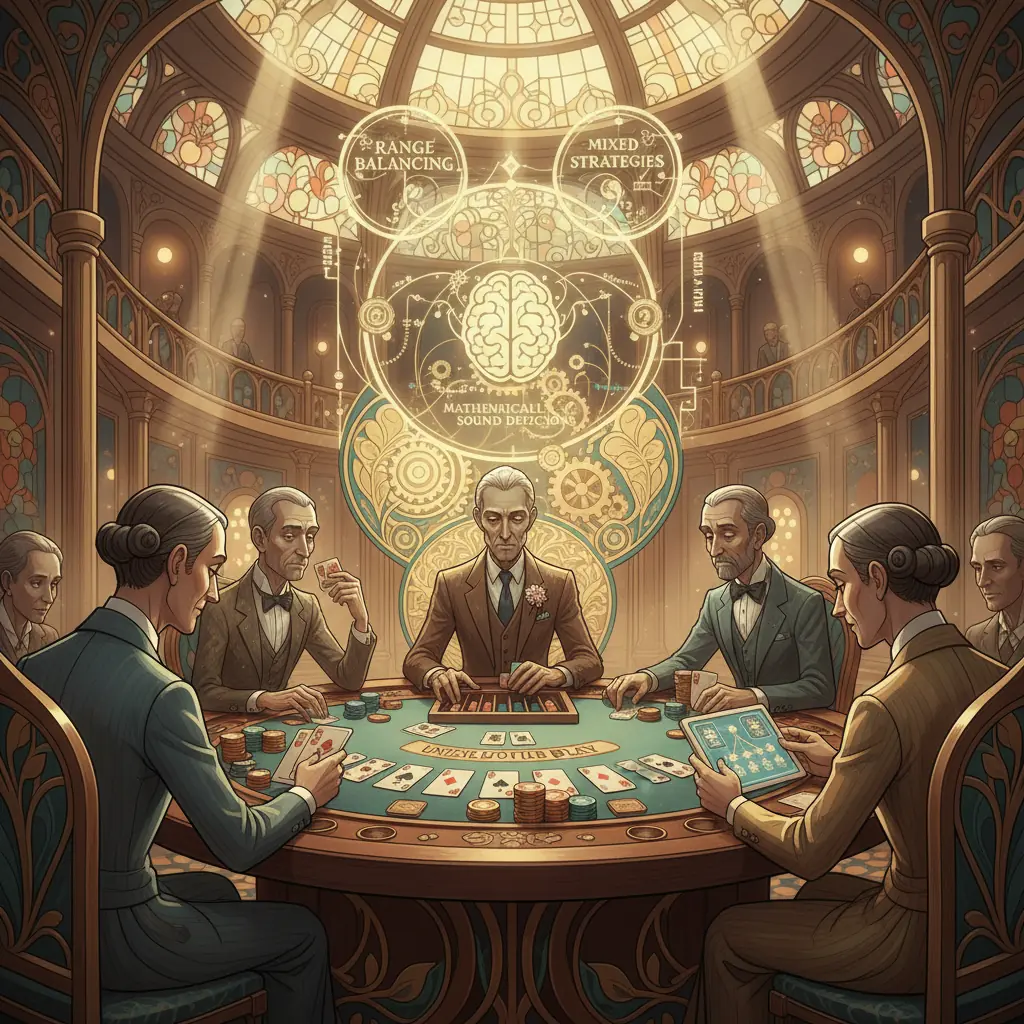
Poker Nash Equilibrium provides a game theory optimal (GTO) strategy, which aims to make a player unexploitable by their opponents. This doesn’t mean winning every pot, but rather making decisions that are mathematically sound in the long run, making it challenging for opponents to profit by deviating from their own optimal strategies. A crucial component involves range balancing. Range balancing means incorporating both strong hands and weaker hands into your betting range in any given spot. Doing this makes it much harder for your opponent to read your hand and exploit you. For instance, on a dry board like Ace-high, a player might bet with Ace-King (strong) and also with suited connectors (weaker hands with backdoor potential) to balance his value to bluff ratio.
GTO poker often involves mixed strategies. Using similar holdings, the play is mixed up. This means that sometimes you bet, and sometimes you check with the same hand. Let’s consider this example: Suppose you are on the button with a hand like King-Queen suited on a flop of Jack-Ten-Seven. Nash Equilibrium might dictate that you bet 60% of the time and check 40% of the time. This randomization prevents opponents from exploiting a predictable strategy. By sometimes betting for value, sometimes betting as a semi-bluff, and sometimes checking to control the pot, you become incredibly difficult to play against.
Pot Odds and Bluffing Frequency
Pot odds significantly influence optimal bluffing frequency. Pot odds define the ratio of the amount you must call to the amount already in the pot. The more you need to pay to call, the more often you must bluff to keep your opponent from exploiting your tight play. For example, imagine there is $100 in the pot, and your opponent bets $50. You now have to call $50 to win a total pot of $150. So, your pot odds are 3:1. In these situations, GTO dictates you must defend against bluffs at least 25% of the time. If you call less often than that, your opponent can profitably bluff you every time. In short, a solid understand of pot odds is the key to determining the right bluffing frequency.
Limitations of Nash Equilibrium
While Nash Equilibrium offers a theoretically sound strategy for poker, its practical application faces significant hurdles in real-world poker scenarios. The core of Nash Equilibrium rests on the assumption that all opponents are playing perfectly, adhering to the same equilibrium strategy. However, this is rarely the case. Most poker players, even seasoned ones, exhibit exploitable play and predictable opponent tendencies.
Calculating and implementing Nash Equilibrium in real-time presents another layer of complexity. Poker involves numerous variables, including stack sizes, bet sizes, and board textures. Factoring all of these during a hand to find the Nash Equilibrium can require immense computing power and a vast amount of pre-calculated solutions, often exceeding human capabilities during a live game.
Even when approximated effectively, employing a GTO (Game Theory Optimal) strategy derived from Nash Equilibrium can be emotionally challenging. GTO poker aims for unexploitability rather than maximizing immediate profit in every situation. This means accepting unavoidable losses and variance as part of the long-term strategy. Experiencing bad beats or folding potentially winning hands can be difficult to stomach, even when understood as strategically sound decisions according to GTO principles. Remaining disciplined and sticking to the GTO strategy requires a strong emotional fortitude.
Exploitative Play vs. GTO
In the dynamic world of poker, two dominant strategies often clash: exploitative play and Game Theory Optimal (GTO). While GTO aims for unexploitability by striving for Nash Equilibrium, exploitative play takes a different approach. It’s about identifying and capitalizing on the specific weaknesses and tendencies of your opponents.
Exploitative strategy involves carefully observing opponents, profiling their behaviors, and adjusting your own strategy to directly counter their flaws. For example, if an opponent consistently over-bluffs, an exploitative player will call more often with a wider range of hands. Conversely, against a very tight player, an exploitative approach dictates raising more frequently and bluffing more aggressively, knowing they are likely to fold marginal hands.
While GTO provides a solid, balanced foundation, exploitative play can often be far more profitable in real-world poker scenarios, especially against weaker or predictable opponents. GTO shines when facing skilled, balanced players where exploiting tendencies are difficult to identify. However, the vast majority of poker games are populated with players exhibiting clear patterns and biases. Recognizing these “tells” and deviations from optimal play is where an exploitative strategy becomes invaluable.
The decision to deviate from GTO and embrace an exploitative approach hinges on your ability to accurately read your opponents. Effective opponent profiling is key. Are they overly aggressive? Are they passive and predictable? Are they risk-averse? Answering these questions allows you to tailor your strategy for maximum profit, turning their weaknesses into your strengths. For instance, imagine a player who always folds to aggression on the river. GTO might suggest checking back a marginal hand some percentage of the time. However, an exploitative play would be to bet close to 100% of the time, extracting value (or bluffing) with near impunity.
Tools for Implementing Nash Equilibrium
In the complex world of Game Theory Optimal (GTO) poker, mastering Nash Equilibrium is vital. Fortunately, players have access to software and resources that significantly assist in studying and implementing these strategies. These tools don’t replace understanding the game, but vastly improve one’s ability to develop solid GTO play.
Poker Solvers: Software such as PioSolver and GTO Wizard have become indispensable aids. These poker solvers work by simulating millions of poker hands, exploring every possible scenario and decision point. The result is a calculated strategy that aims to be unexploitable, or as close to it as possible.
GTO Software: GTO Wizard, for example, offers pre-calculated solutions for a wide range of situations. Players can study these solutions to identify optimal actions, bet sizings, and frequencies in various spots. This allows for quick learning and refinement of strategies without having to run simulations from scratch constantly.
It’s worth noting that even professional poker players depend on sophisticated AI to find the best strategies, especially since understanding Nash Equilibrium and GTO strategies can be unbelievably complex. The key is to remember that these tools are meant to enhance, not replace, a player’s understanding of poker dynamics. They provide a framework for making informed decisions and continuously improving one’s game.
Conclusion: Mastering the Fundamentals and Beyond
Nash Equilibrium provides a robust framework for understanding game theory optimal (GTO) poker, but it is not the be-all and end-all of poker strategy. It’s a foundation upon which to build a more nuanced and adaptable approach to the game. The real power of GTO lies in understanding why it suggests certain plays, not just mindlessly following them.
Remember, GTO is about unexploitability. It aims to make you indifferent to your opponent’s strategy. However, in the real world, opponents deviate from GTO. This is where exploitative play comes in. Identifying and capitalizing on these deviations is crucial for maximizing your winnings. A balanced approach involves using GTO as a baseline and then adjusting your strategy based on your opponent’s tendencies.
The world of GTO poker is constantly evolving. New tools and solvers emerge regularly, allowing for deeper analysis and more sophisticated strategies. Embracing this continuous learning process will keep you ahead of the curve. Explore different GTO resources, experiment with solvers, and analyze your own play to identify areas for improvement. As GTO poker continues to evolve, as it has been doing significantly, you need to stay on top of its concepts.
Ultimately, becoming a successful poker player involves blending a solid understanding of Nash Equilibrium with the ability to read your opponents and exploit their weaknesses. Don’t be afraid to deviate from GTO when the situation calls for it. Embrace the complexity of the game, and keep learning!